
Two products can look alike without being equivalent. Discover the 7 essential criteria for distinguishing an original product from an imitation before choosing your flooring. Today, it is very easy to compare products online. With a search and a few clicks, you can find several solutions that sometimes look remarkably similar: the same appearance, similar dimensions, a comparable interlocking system, identical colours, or even photos that give a sense of déjà vu. But one question is worth asking before comparing prices alone:
Is a product that looks like the original actually equivalent?
When choosing flooring designed to last for years, appearance is not enough. Materials, design, manufacturing, quality control, performance, warranty, and the manufacturer’s experience can make a real difference. This is especially true for modular flooring and interlocking tiles, where some products may borrow visual features from solutions already on the market. At SWISSTRAX, this question is particularly important because the RIBTRAX tile, one of the brand’s flagship models, benefits from many years of design and manufacturing experience. So how can you tell the difference between an original product and an imitation? 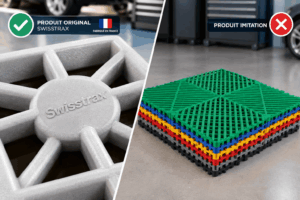 Here are the 7 points to check before buying your flooring.
1. Original or imitation: who actually makes your product?
This is the first question to ask. When you find a product online, you usually know who is selling it. But do you really know who manufactures it? This distinction matters. A distributor can sell a product without having designed or manufactured it. Before ordering, find out:
- who actually manufactures the product;
- where the company is based;
- where its manufacturing plant is located;
- how long it has been making this type of product;
- whether it genuinely controls its production;
- how to contact the manufacturer;
- what warranties it offers.
A clearly identified manufacturer is a first sign of trustworthiness. Chez SWISSTRAX, the RIBTRAX product has a clearly identifiable industrial history, with design developed by the brand and European manufacturing carried out in France by SWISSTRAX Europe located in 60400 Crisolles. The original has an identifiable manufacturer, history, and expertise.
2. Check where your flooring is actually made
The place of manufacture is another essential criterion. Two products may look alike yet come from very different places. One may be made in France, while the other is imported from the other side of the world. This alone does not determine a product’s quality. However, it is important information to know before comparing two solutions. Ask yourself these questions: Where is the product made? Where are its different components or materials made? Who oversees production? Does the manufacturer operate its own production facilities? Is the product’s origin clearly stated? Can you verify this information? Chez SWISSTRAX Europe, the tiles intended for the European market are made in France, in the Hauts-de-France region. For consumers who want to prioritise French manufacturing, this is useful, concrete information. Before comparing two products that look alike, compare their origin. Beware of vague wording such as “French manufacturer”: it does not tell you where the product is made.
3. Don’t rely on appearance alone
This is probably one of the easiest traps to fall into online. A photograph lets you assess a product’s appearance. It does not reveal how it is designed. Two flooring tiles may have:
- a similar structure;
- a comparable interlocking system;
- similar dimensions;
- similar colours;
- an almost identical look.
Yet their specifications may be very different. Original or imitation: a photograph does not necessarily tell you:
- the material’s composition;
- its weight;
- its manufacturing process;
- its level of strength;
- its surface treatments;
- its quality-control procedures;
- its service life;
- its warranty terms.
What you can see is not always what makes the difference. That is why a meaningful comparison must go beyond images.
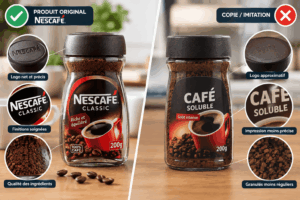
4. Original or imitation: compare the technical specifications
This is where the comparison becomes truly useful. Before buying your flooring, take the time to read its technical data sheet. In particular, look for:
- the material used;
- thickness;
- dimensions;
- weight;
- structure;
- mechanical strength;
- temperature resistance;
- chemical resistance;
- UV protection;
- conditions of use;
- the manufacturer’s recommendations.
For the floor tile RIBTRAX PRO, SWISSTRAX lists, among other specifications, a thickness of 18 mm , manufacture using polypropylene and stated mechanical load resistance of up to 25 tonnes/m². These are precisely the details that allow different products to be compared objectively. A claim such as “ultra-strong” is a marketing statement. Some tile retailers claim load resistance of up to 50 tonnes/m², but is this proven? Are you shown a load-resistance test report? A documented technical specification provides information that can genuinely be compared. So don’t just compare two designs: compare their specifications.
5. Look at the warranty—but above all, who stands behind it
The warranty period is another factor to check. But here again, looking at a number is not enough. A warranty is meaningful only if you know: Who provides the product warranty? Who should you contact if there is a problem? Where is the company based? Is the manufacturer clearly identified? Are the warranty terms available?
In the case of RIBTRAX PRO, SWISSTRAX Europe offers a 10-year manufacturer’s warranty for private customers and 5 years for professional customers.
This helps consumers better understand what they are buying and the manufacturer’s commitment. When comparing two products, compare not only the warranty period but also the company responsible for it. Also check the terms and conditions of sale to make sure the product is covered for professional use too. Imitation products often do not come with a warranty for business customers.
6. The manufacturer’s experience matters
An original product usually represents much more than just a shape. It involves:
- years of design work;
- testing;
- material choices;
- ongoing improvements;
- customer feedback;
- industrial processes;
- quality control;
- experience built up over time.
SWISSTRAX has been developing modular flooring solutions for more than 20 years. This experience is part of the brand’s history and its products. Why does this matter to consumers? Because an experienced manufacturer knows its product. It can explain the product’s design, specifications, and conditions of use. An imitation can copy the appearance of an existing product. It does not automatically replicate the years of experience behind the development and evolution of the original.
7. Don’t compare prices before comparing the products
This is naturally the first thing many people look at when shopping online. What is the price per square metre? But when one product looks very similar to another, price should be the last factor you compare. Why? Because two products that look similar may differ in terms of:
- material;
- manufacturing;
- thickness;
- product weight;
- strength;
- finish;
- treatments;
- warranty;
- after-sales service;
- origin;
- traceability.
Comparing price alone can therefore mean comparing products that are not truly equivalent. A better approach is to compare:
Price + specifications + manufacturing + warranty + manufacturer + experience.
Only then does the price comparison really make sense.
Original or imitation: 7 questions to ask before buying

Before ordering your next floor, take a few minutes to answer these seven questions:
1. Who actually manufactures the product?
Is the manufacturer clearly identified and named on the product’s technical data sheet?
2. Where is it made?
Is the country of manufacture clearly stated on the technical data sheet?
3. What material is used?
Is the composition known and documented? Is the material type specified, along with the name of the material supplier? SWISSTRAX, for example, identifies TOTAL as its polypropylene supplier.
4. What are its technical specifications?
Thickness, weight, strength, operating temperatures, treatments, UV resistance…
5. What warranty comes with the product?
And above all, who is responsible for that warranty?
6. What experience does the manufacturer have?
How long has it been designing and manufacturing this type of product?
7. Will you be able to identify and contact the manufacturer in the long term?
Is there a real company behind the product and a contact person who is easy to reach? If you don’t have the answers, take the time to find out before placing your order.
Why are some imitations so difficult to identify?
Because an imitation is not necessarily obvious at first glance. It may copy certain features that have made an existing product successful:
- its shape;
- its appearance;
- its interlocking system;
- its dimensions;
- some colours;
- its presentation.
This can make comparison difficult for consumers. That is precisely why it is best to look beyond appearance. Look at what you cannot see:
- The manufacturer.
- The material.
- The manufacturing process.
- The technical specifications.
- The warranty.
- Traceability.
- Experience.
This is the information that tells you what you are really buying.
RIBTRAX tiles: how can you make sure you’re choosing the original rather than an imitation?
The interlocking floor tile RIBTRAX is one of SWISSTRAX’s flagship models. It is based on a modular interlocking tile system designed for garages, workshops, showrooms, and other spaces where an attractive, functional floor covering is required. As visually similar solutions become more common on the market, it is increasingly important to verify the information about the product you are buying. So the right question is not simply:
“Does this product look like RIBTRAX?”
But rather:
“Am I actually buying an original SWISSTRAX RIBTRAX?”
To answer that, check the manufacturer, origin, technical specifications, and warranty. 
French manufacturing is part of SWISSTRAX’s identity
For customers who want to prioritise French manufacturing, the product’s origin is an important consideration. SWISSTRAX tiles intended for the European market are made in France by SWISSTRAX Europe, in the Hauts-de-France region. This French production makes the product’s manufacturing origin clear. It also reflects an approach focused on control over manufacturing and proximity to the European market. When two products look alike, their place of manufacture is one of the first things to check.
Original or imitation: know the difference before you buy
Choosing flooring is an investment. It is therefore natural to look for the best balance of price, quality, and durability. But when several products look identical, immediately choosing the cheapest is not necessarily the best approach. Take the time to compare.
- Compare the manufacturer.
- Compare the origin.
- Compare the materials.
- Compare the technical specifications.
- Compare the warranties.
- Compare the experience.
Only then should you compare prices. Because two products that look alike are not necessarily equivalent.
Why choose the original SWISSTRAX RIBTRAX?
RIBTRAX is the result of more than 20 years of SWISSTRAX’s experience in developing modular flooring solutions. For the European market, it is manufactured in France by SWISSTRAX Europe. The product comes with technical documentation, a manufacturer’s warranty, and a clearly identified manufacturer. This combination helps consumers know exactly what they are buying. The original is about more than appearance. It is also defined by its manufacturer, history, design, manufacturing, and the information provided with it. You can also read our dedicated article comparing a French-made tile with an imported tile. 
Before you buy, simply ask yourself this question
When you find a product that looks like another, don’t ask only:
“Which one is cheaper?”
First ask yourself:
“What is the difference between the two products?”
And above all:
“Am I buying the original or just an imitation?”
This simple question can lead you to look at the information that really matters.
Discover the original SWISSTRAX RIBTRAX
Would you like to fit your garage, workshop, or showroom with modular flooring? Discover the specifications of the original SWISSTRAX RIBTRAX tile, how it is manufactured, and the solutions available for your project.
SWISSTRAX — RIBTRAX: the original flooring tile, made in France.